 "
"
The Product Leader’s role in helping teams succeed with OKRs






TL;DR
OKR planning is hard in large organizations — and it gets harder when product leaders are either too hands-off or accidentally micromanage the process. The product leader’s role is to thread the needle: provide enough strategic context for teams to make aligned decisions, without turning that context into a top-down mandate. Three core responsibilities define this well — providing direction, helping teams explore the opportunity space without jumping to the first idea, and acting as a quality guardian for key results. In process terms, this plays out across four stages: the kick-off, working sessions to refine KRs, reviewing team drafts as a coach, not an approver, and managing cross-team dependencies when teams can’t resolve conflicts themselves. The goal throughout is empowered teams, not dependent ones.
An Overview
For some reason, OKR planning in most companies is a stressful moment that we go through each quarter. We need to consider myriads of inputs, definition sessions, and cross-team alignments to create high-quality OKRs for our team.
While this is challenging for organizations of any size, large enough organizations (usually more than 8 product teams) also have to deal with difficult dependencies and different functional or business unit alignment that adds an extra layer of complexity.
But this won’t be another article about setting OKRs. These large organizations usually have product leaders (with titles like Directors of Product, Heads of Product, Product Lead, etcetera). And the question I’ll try to answer is: what is the product leader’s role in the OKR setting phase?
For clarification, this will not be about the CPO’s role. It’s about the product organization’s middle management.
Background
While, in essence, it may be clear that the role is to support the teams in their OKR creation, many times, processes and responsibilities are not always precise.
For example, upper management will have priorities that they want to see reflected in teams’ efforts. Balancing the level of top-down direction with the freedom of bottom-up team discussions is no easy endeavor. You can fail to deliver the alignment that upper management expects or fail to give the team enough room to analyze and present their ideas.
To avoid making a long list of difficult situation examples, let’s jump into the responsibilities and the role in different process steps for the product leader.
Responsibilities
While the list will probably vary with specifics for each company, I believe 3 key responsibilities must be present to truly support empowered teams:
1. Provide context and direction
First and foremost, product leaders should provide context for teams to make informed and aligned decisions. Leaders should understand the company’s vision and strategy, be able to communicate it in a meaningful way, and clarify the role their “unit” plays in that strategy.
This doesn’t mean they should have all the answers. Part of empowering the team is letting them explore the opportunity space and even challenge the strategy. But the strategic direction should be clear to help the team make the right assessments and select aligned problems to solve.
I consider it important to have these discussions not only directed towards the product managers but to the “product trio” or even all team members. Of course, engineering and design leaders should participate, but none of these leaders should isolate feedback directed to their discipline.
A good OKR Planning is always required and we have taken care of this from our side, to provide you with the right tools.
2. Help with opportunity space exploration
Depending on the team’s seniority and skills, they may need a little help to map the context and direction to the opportunities they can pursue.
How can the product lead help?
- Ask to review and challenge the opportunities the team is considering. Tools like an Opportunity Solution Tree can help the typical “go ahead with the first idea we have.”
- Ask and challenge the value of opportunities: instead of having pure ideation and opinion-based decisions, try to make the team explore the facts and results to support the listed options.
- Help teams build their assumptions and hypotheses: similarly, the expected impact of an opportunity will be based on unknowns. If we formulate, we can later explore (and pivot if incorrect).
3. Push for high-quality KRs
Finally, no matter how much we say OKRs are an easy framework, having high-quality key results is hard.
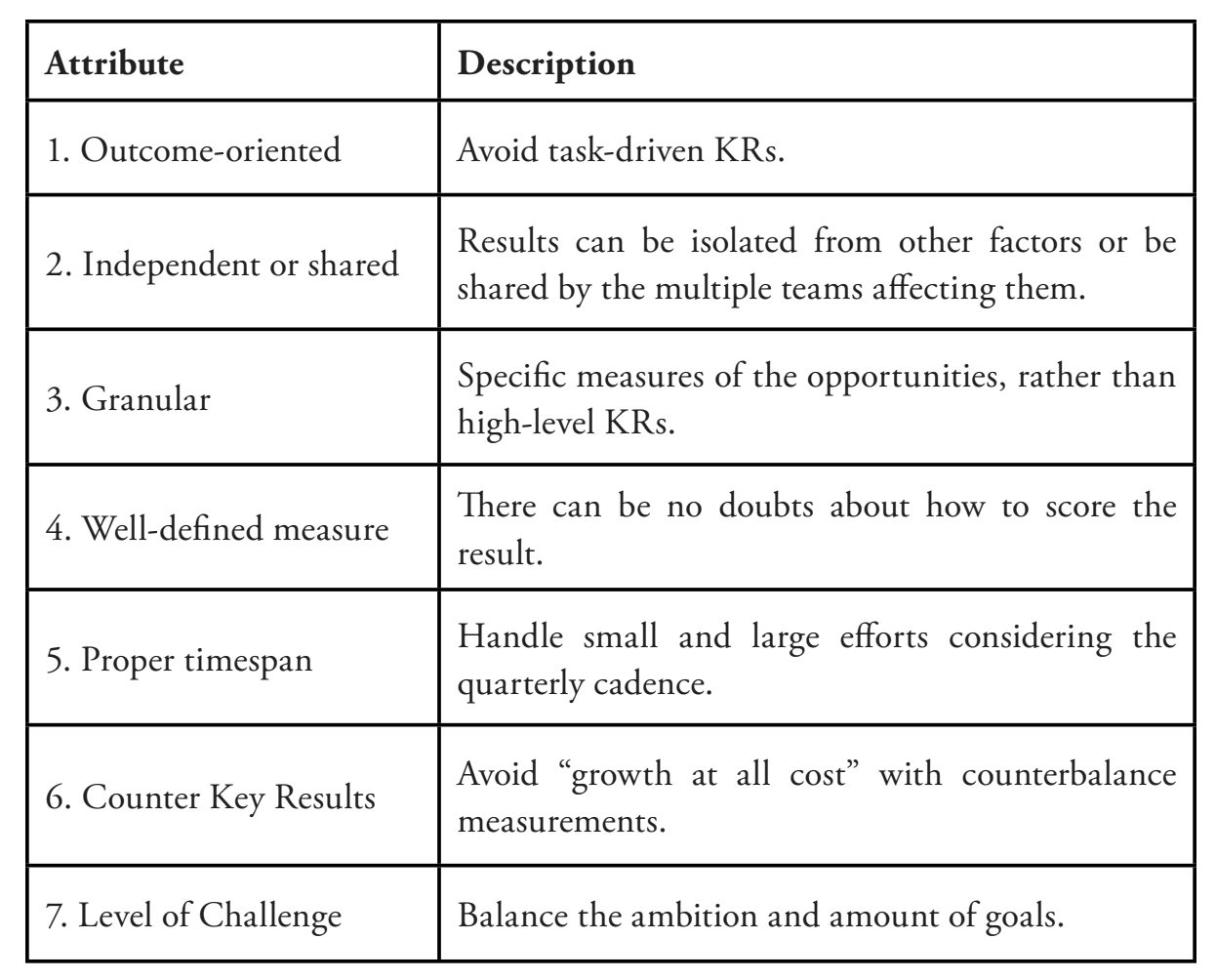
So a vital responsibility of the head of product is being that guardian of quality, signaling, and challenging when a KR has room for improvement. This should be a coaching opportunity, helping teams understand the quality attributes and why they are essential.
The role in the process
Besides the responsibilities, we can also mention their involvement in the different steps of the OKR creation process. Of course, this can vary widely from company to company, but let me explore a few of the typical steps.
1. The kick-off and “unit” level OKR draft
The beginning of the OKR preparation season is the moment to provide context. We usually do it with a kick-off meeting where we present the strategy with the most pressing topics or goals.
Some companies also use OKRs per unit, which usually product leaders are in charge of presenting. The kick-off should not include a detailed version of them, but an initial draft can help guide the team, as long as they interpret them as ideas to be explored and challenged and not top-down mandates.
2. Helping define KRs and explore select opportunities
After providing context, the teams will start working on their definitions. The leader can have smaller rounds with each team or each Product Manager to help explore the opportunities and how to measure them.
These meetings can resemble workshops or working sessions, where they explore the OST, and everyone can discuss how to measure them. It is an excellent chance to challenge both assumptions and key results to improve quality.
3. Review team drafts
Once teams have drafts ready, leaders can use another 1:1 or small group meeting to provide feedback before presenting them to larger groups. Again, this is a coaching opportunity, and it shouldn’t be “approval” or “veto” time.
4. Dependencies
Chances are, especially in large and complex organizations, that teams have dependencies. To achieve your challenging KRs, you will need collaboration from other teams. Likewise, other teams will approach you looking for help with their goals.
Ideally, this is a process that teams can solve on their own. If the context is clear and priorities easy to understand, there are good chances that teams can debate and agree on which are the most critical opportunities to pursue when conflicts arise.
Suppose teams don’t reach an agreement. In that case, it is appropriate that they escalate it to the product leader, who hopefully can bring more context and help decide which team’s objectives have higher priority. (And take it as feedback for future rounds since the context was not clear for teams).
Conclusion
One of the more challenging leadership problems to solve within each step of the OKR cycle is the product leader’s role. It is difficult because the nature of the problems is the same on both sides of the equation, and both fail. Major problems include too much or too little direction. If too much direction is imposed, the team achieves the OKR with the wrong intent, thus losing ownership. If too little direction is provided, the team wastes time on activities that do not contribute to the overall objective.
The article identifies context, challenge, and quality, which narrow that gap. A team that knows the rationale behind the strategic direction, has been challenged to think beyond the assumptions they so readily act upon, and has been mentored on how to define and measure key results can now execute its OKR cycles on its own. A product leader’s role is to empower the team and remove themselves as the constraint.
This flywheel system only works when teams are provided with the infrastructure to draft, update, and review OKRs. This infrastructure will also house objectives between review cycles and allow teams to document their progress without having to report it in a weekly progress meeting.
👉 See how Woffice’s built-in OKR feature supports product teams throughout the full cycle
FAQs
What is the product leader’s role in OKR planning?
The product leader’s role in OKR planning is to support empowered teams — not to dictate outcomes. This means providing strategic context so teams understand the direction they’re working within, helping them explore opportunities rigorously rather than defaulting to the first idea, and acting as a quality coach for key results. The goal is to balance top-down alignment with enough bottom-up freedom that teams feel genuine ownership over their OKRs.
What is the difference between top-down and bottom-up OKRs?
Top-down OKRs are set by leadership and cascaded to teams — ensuring alignment but risking low team ownership and poor buy-in. Bottom-up OKRs are generated by the teams themselves — ensuring ownership but risking misalignment with company strategy. Most effective OKR processes combine both: leadership provides strategic direction and context at the kick-off, teams draft their OKRs within that frame, and product leaders review and coach the output before it’s finalized. Neither extreme alone works well at scale.
What are high-quality key results and how do product leaders ensure them?
A high-quality key result is specific, measurable, time-bound, and directly tied to the objective it supports — not a task or output, but an outcome that signals real progress. Product leaders ensure quality by treating the review process as a coaching opportunity rather than an approval gate: challenging whether a KR is outcome-oriented, asking whether it can be scored objectively, and flagging where teams have defaulted to activity metrics instead of impact metrics. The aim is to raise the team’s ability to write good KRs over time, not just fix them each quarter.
How should product leaders handle OKR dependencies between teams?
The ideal is that teams resolve dependencies themselves — if strategic context is clear, teams can usually negotiate priorities when conflicts arise. When they can’t, the product leader steps in to provide additional context and help determine which team’s objectives have higher organizational priority. Escalated dependency conflicts are also useful feedback: if teams frequently can’t resolve them independently, the strategic context probably wasn’t clear enough at the kick-off stage.
What is an Opportunity Solution Tree and how does it help OKR planning?
An Opportunity Solution Tree (OST) is a visual framework that maps a desired outcome to the opportunity space beneath it — the customer problems, needs, and pain points that, if addressed, would contribute to that outcome. In OKR planning, product leaders can use it to push teams beyond their first idea and systematically explore which opportunities are most worth pursuing before committing to key results. It’s particularly useful for preventing teams from reverse-engineering OKRs around solutions they’ve already decided to build.